Launch offer — valid today only

📄 Digital book in PDF · read it on your phone or print it

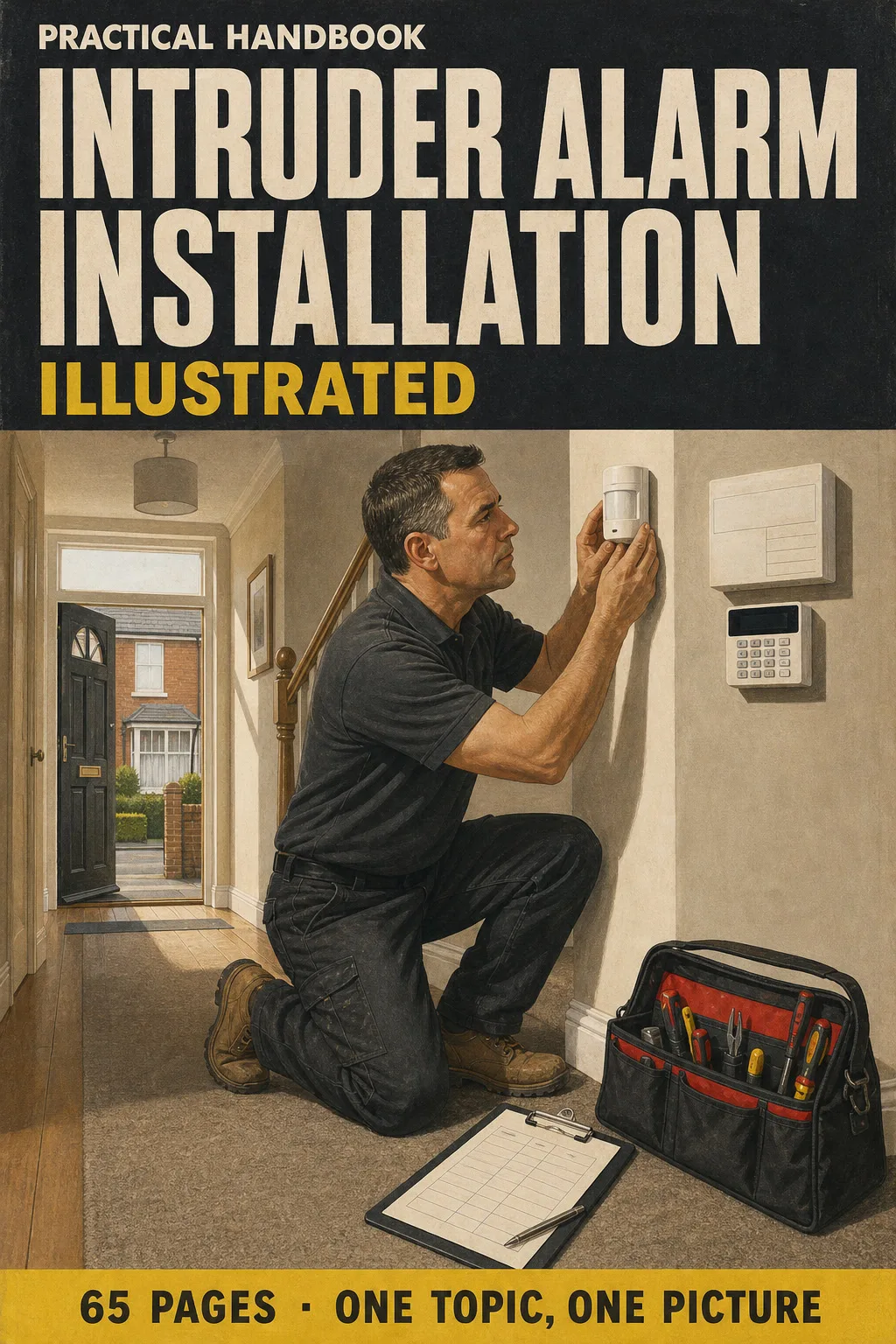
Intruder Alarm Installation Illustrated, for UK Installers Fit, Commission and Fault-Find in the Same Order Every Time

The whole system as one diagram, security grades, PIR positions, zone types, EOL and tamper wiring, standby batteries, commissioning, fault finding and service visits. Every topic has its own page: the drawing first, then what you need to remember. 65 illustrated pages.

I WANT THE WHOLE JOB DRAWN

🔒 Secure checkout · PDF by email · 30-day guarantee

Every topic, its own pageEvery loop, position and check drawn, with the explanation beside it
65 illustrated pages8 parts, from the whole system at a glance to the whole job on one page
Up-to-date sourcesBS EN 50131 with PD 6662, BS 9263 and BS 7671
PDF by emailFormat

Look Inside the Book

Every page has one big drawing and a box with the values, rules and steps you need to know:

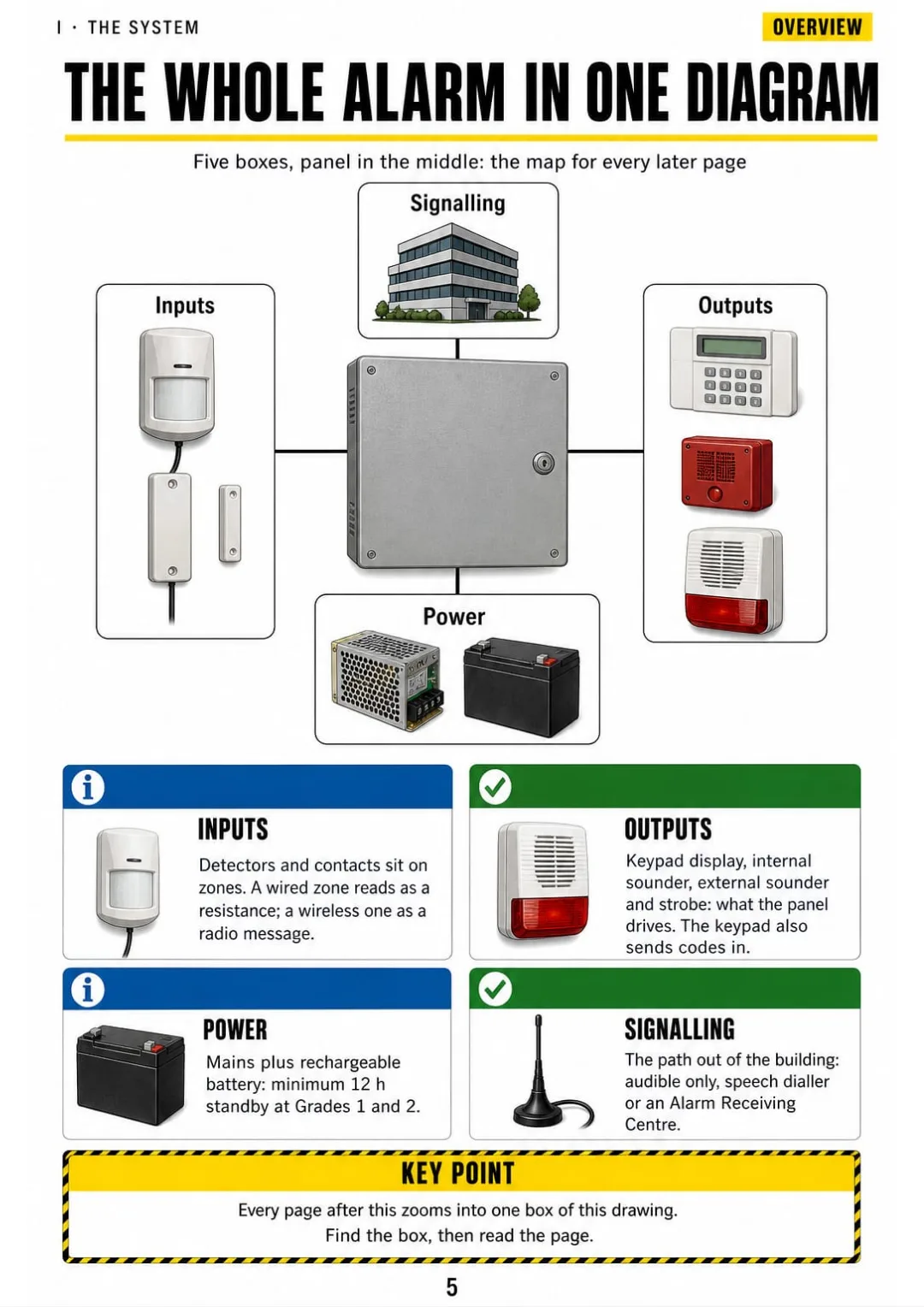
Zones in, keypad and sounders out, power underneath, signalling to the outside world.
Users, pets, part set, keyholders, monitoring, insurer: ask before you quote
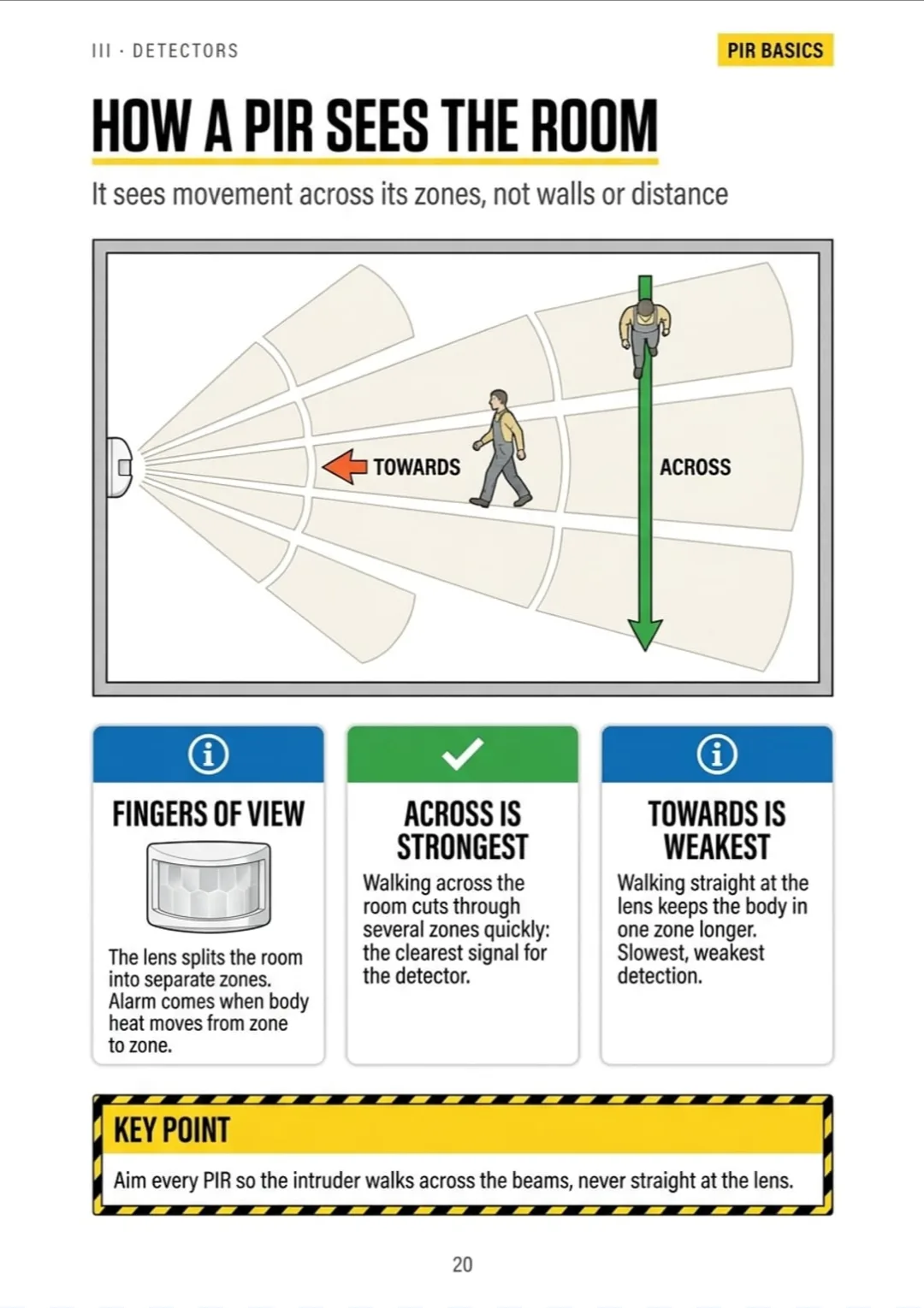
Walking across the zones triggers best; walking straight at the PIR is the weakest case.
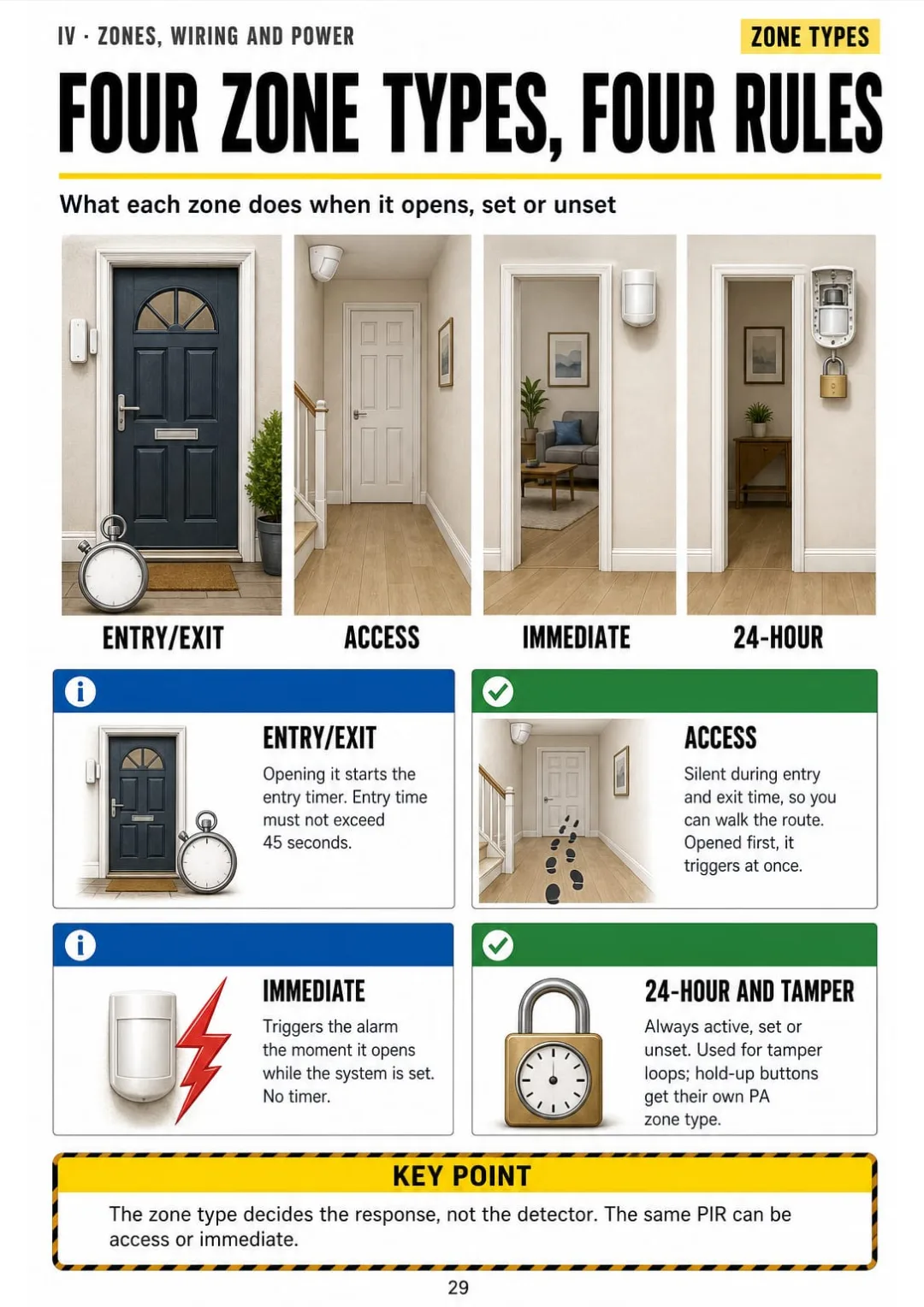
Entry/exit, access, immediate and 24-hour: one door, one rule each
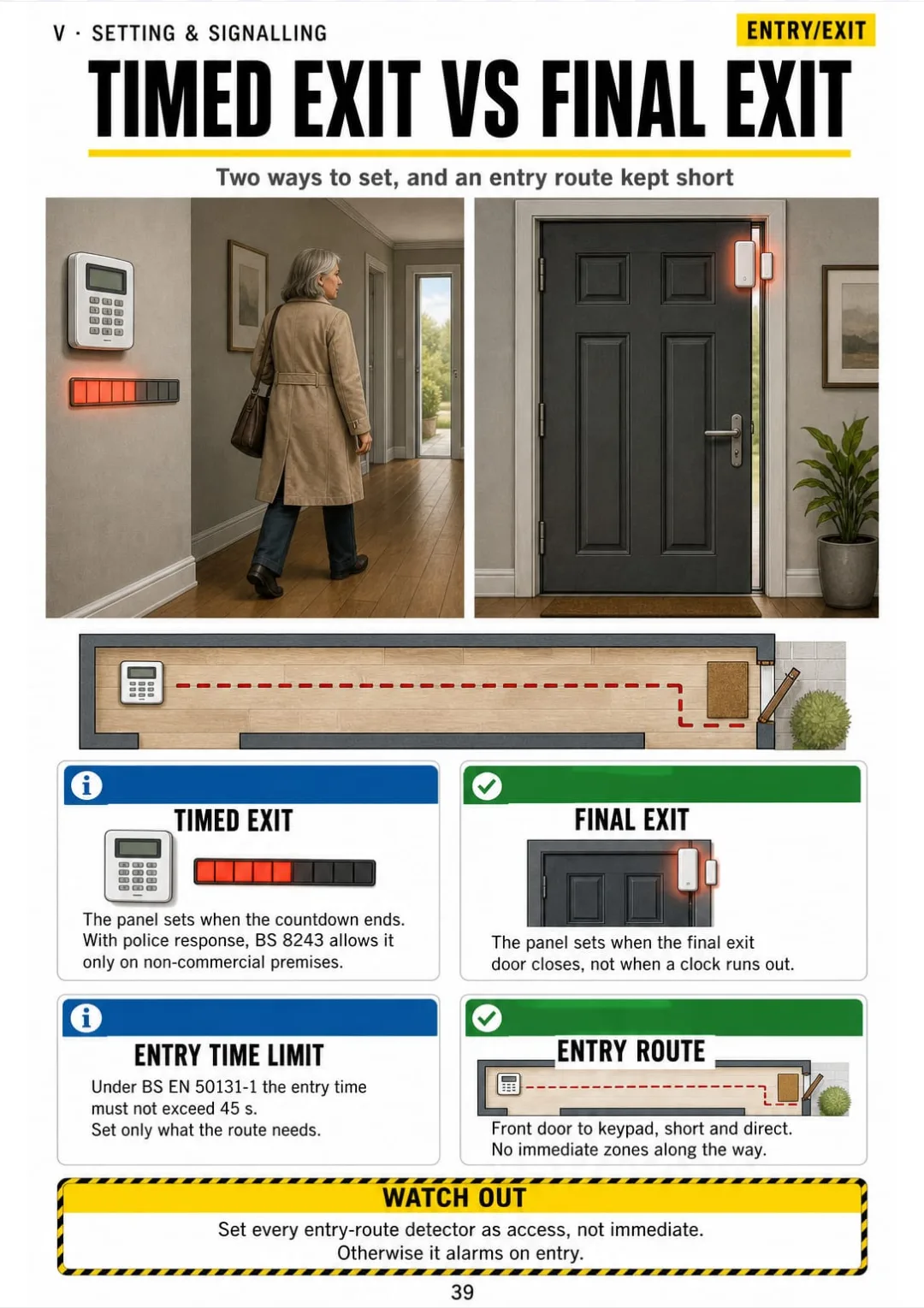
Timed exit vs final exit, and an entry time of no more than 45 s
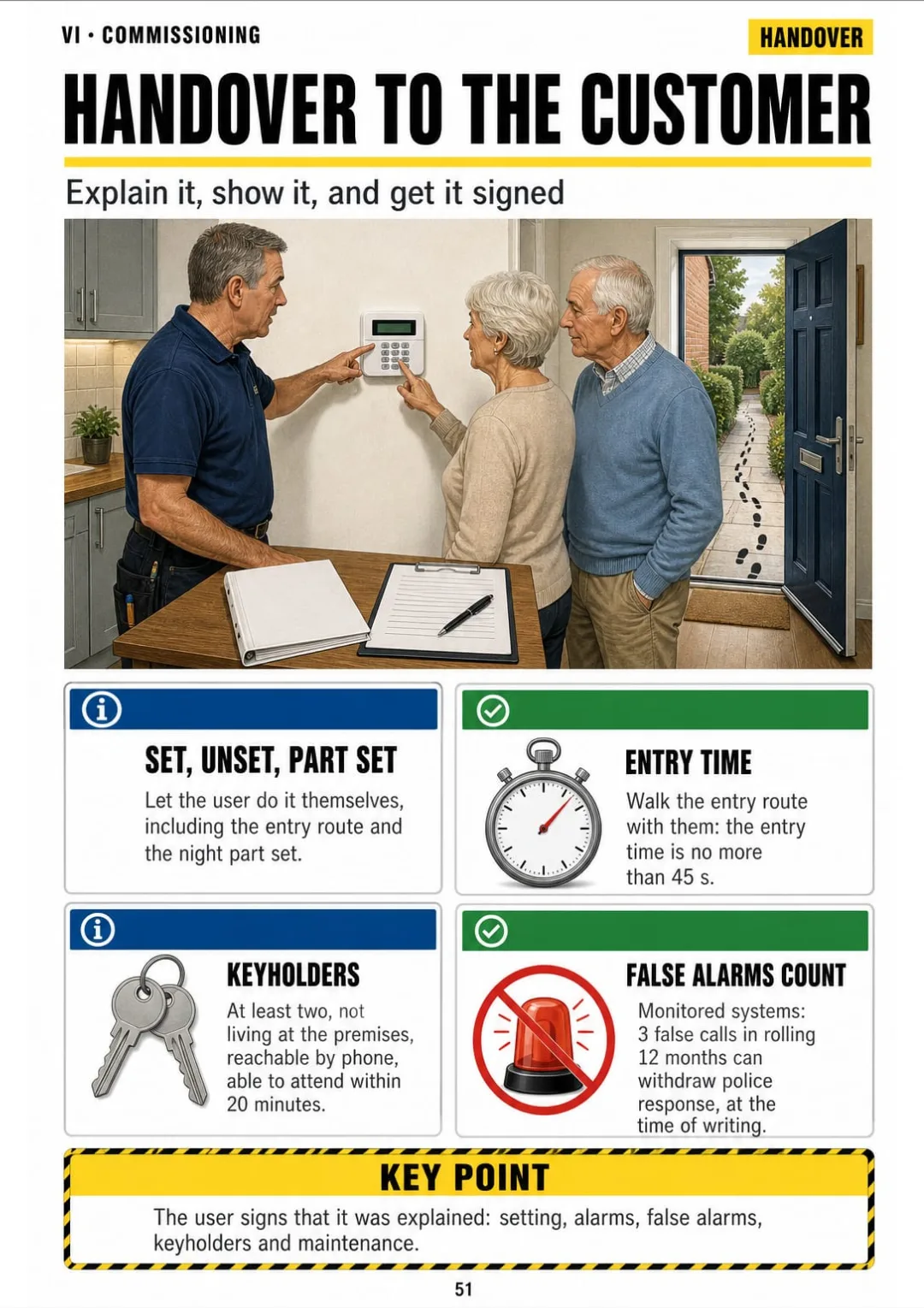
Handover: setting and unsetting, entry route, part set, keyholders, false-alarm limits, user signature.
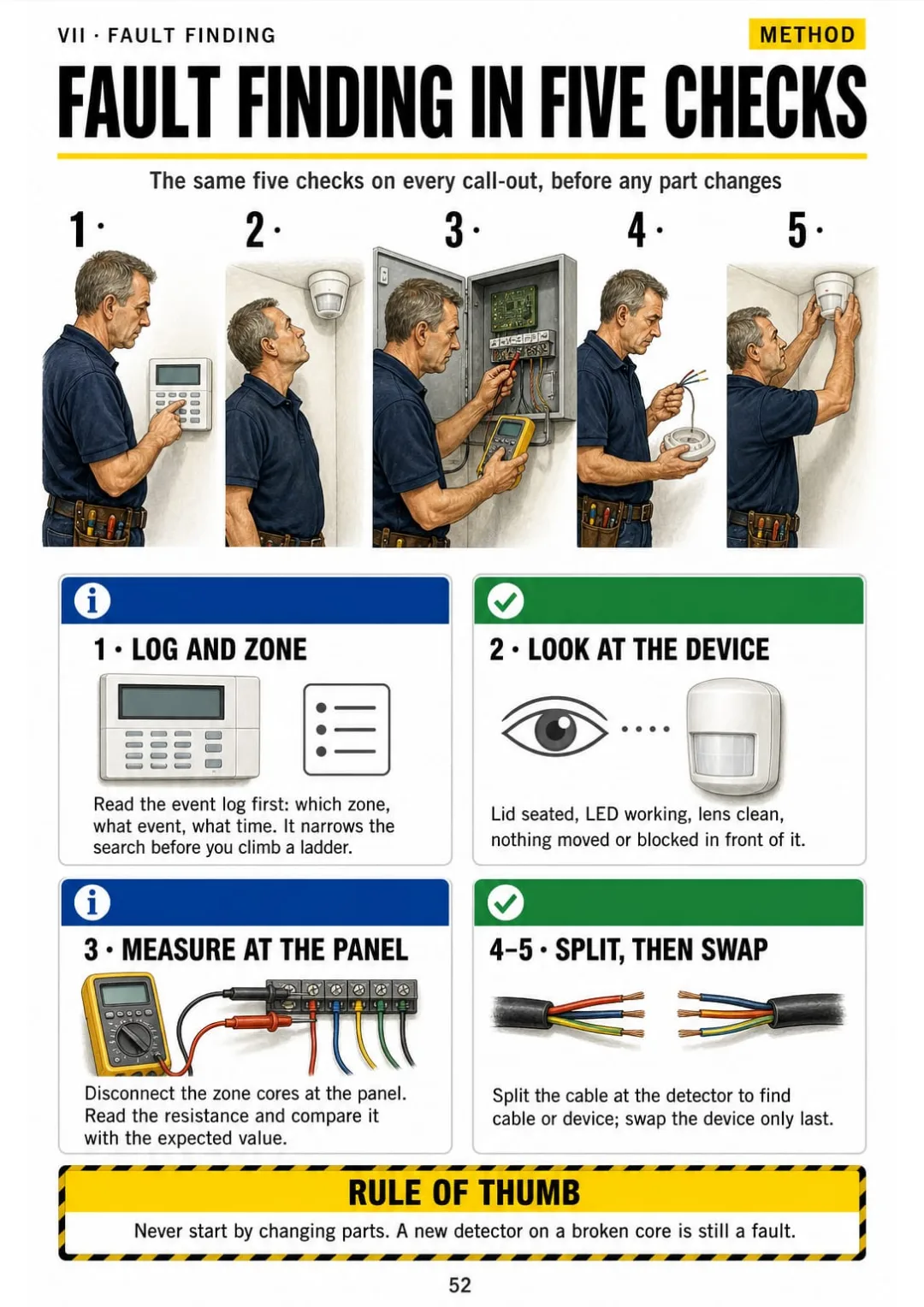
Log, look, measure, split, swap: five checks, always in that order
Replace on a failed load test or by the maker's service life, and date every battery.

Swipe to see more →

These are real pages from the book. The table of contents is the full one: 8 parts and 61 topics.

The Problem Isn't You. It's How It Was Explained to You.

You're walk-testing a new PIR in the customer's lounge. You walk straight towards it and the LED barely flickers. The customer is watching from the doorway.

The manufacturer's leaflet covers it in three paragraphs of small print and a coverage pattern seen from the side. Nobody ever drew that pattern onto a real room.

Walking across the zones triggers best; walking straight at the PIR is the weakest case.

In this book, the PIR has its own page: the room seen from above, the zones fanning out, a person walking across them (the strongest trigger) and a person walking straight at it (the weakest case).

The same goes for mounting height, corner mounting, the places a PIR must never face, pet-tolerant detectors, door contacts and the tamper loop: each one on its own page.

You see why it goes in that corner, you fit it, and you walk-test it without going back to the manual.

COMPARE FOR YOURSELF

The Same Topic, Two Ways to Learn It

THIS
  • The manual: line after line of small print
  • Standards and wiring loops explained only in words
  • You arrive on site still unsure
Intruder and hold-up alarm systems installed in the United Kingdom are generally specified with reference to BS EN 50131-1, which is to be read in conjunction with the UK application document PD 6662, setting out the manner in which the European series is applied domestically. Commissioning, maintenance and handover are addressed separately within BS 9263, whilst BS 8243 concerns the design and configuration of systems intended to generate confirmed alarm conditions. The mains supply to the control equipment shall, in addition, satisfy the relevant requirements of BS 7671.
FOR THIS
  • Every standard on one map, every loop in a drawing
  • The values and steps in one box
  • You see it and you get it
Users, pets, part set, keyholders, monitoring, insurer: ask before you quote
CONTENTS

Take a Look at the 8 Parts and 61 Topics

The system at a glance, standards and the survey, detectors, zones, wiring and power, setting and signalling, commissioning, fault finding and service: 65 pages, all illustrated

IThe system at a glance · pp. 5-11
  1. The whole alarm as one block diagram
  2. What the control panel actually does
  3. Hardwired, wireless or hybrid
  4. Keypads, readers and remote apps
  5. Sounders: internal, external and strobe
  6. How an alarm gets out of the building
  7. The job in eight steps, always in the same order
IIStandards, grades and the survey · pp. 12-19
  1. Which standards apply in the UK
  2. Security grades 1 to 4 in one picture
  3. Choosing the grade from the risk
  4. Environmental classes I to IV
  5. Notification options in plain English
  6. The site survey walk-round
  7. Questions to ask the customer before you quote
  8. The written specification and quote
IIIDetectors and where they go · pp. 20-28
  1. How a PIR sees: zones, not walls
  2. PIR mounting height and corner position
  3. Where a PIR must not point
  4. Dual technology and anti-masking detectors
  5. Pet-tolerant detectors: what they really allow
  6. Door contacts: magnet, gap and fixing
  7. Glass, shock and vibration sensors
  8. Hold-up and panic buttons
  9. Detector layout on a typical semi-detached house
IVZones, wiring and power · pp. 29-38
  1. Zone types: entry, access, immediate, 24-hour
  2. Planning the zone list
  3. Alarm cable: cores and what each one does
  4. The tamper loop drawn wire by wire
  5. End-of-line resistors: how the panel reads a zone
  6. Wiring a PIR with EOL and alarm resistors
  7. Voltage drop on long cable runs
  8. Mains supply to the panel under BS 7671
  9. Segregation and cable routes
  10. Standby battery sizing step by step
VSetting, signalling and confirmation · pp. 39-44
  1. Entry and exit: timed exit vs final exit
  2. Part set for night time
  3. Bell delay, cut-off and the strobe
  4. Alarm transmission: single path and dual path
  5. Confirmed alarms for police response
  6. Police response and false-alarm limits
VICommissioning and handover · pp. 45-51
  1. Before you power up: the dead checks
  2. First power up in the right order
  3. Programming: the order that avoids rework
  4. The walk test, room by room
  5. Testing sounders, battery and signalling
  6. The commissioning certificate
  7. Handover to the customer
VIIFault finding and false alarms · pp. 52-59
  1. Fault finding in five checks, always in the same order
  2. Tamper fault: where to look first
  3. Zone open or will not set
  4. False alarms from detectors
  5. False alarms from users
  6. Low voltage, battery and mains faults
  7. Signalling and communication faults
  8. Intermittent faults: catching them
VIIIService and quick review · pp. 60-65
  1. Routine maintenance visits
  2. The service checklist
  3. When to replace a battery
  4. Adding to or upgrading an existing system
  5. The most frequent mistakes on a job
  6. The whole job on one page

One Page, One Topic, All Clear

Think of it this way:

It's half past six, the panel says Tamper, and the customer wants to know if they can set the alarm tonight.

You open the book at the tamper fault page and see the loop drawn wire by wire, with the first place to look marked on the drawing.

Timed exit vs final exit, and an entry time of no more than 45 s

The same with detector positions, end-of-line resistors, standby battery sizing, the dead checks and the walk test: each one on its own page.

Intruder Alarm Installation Illustrated is 8 parts and 61 topics, all drawn, and at the end the most frequent mistakes on a job and the whole job on one page.

What you see drawn, you don't have to memorize.

What's Inside Intruder Alarm Installation Illustrated:

Ipp. 5-11

The system at a glance

The whole alarm as one block diagram, what the panel does, hardwired, wireless or hybrid, keypads, sounders, signalling and the job in eight steps

IIpp. 12-19

Standards, grades and the survey

Which UK standards apply, security grades 1 to 4, choosing the grade, environmental classes, notification options, the survey and the quote

IIIpp. 20-28

Detectors and where they go

How a PIR sees, mounting height, where it must not point, dual tech, pet-tolerant detectors, door contacts, glass and shock sensors, hold-up buttons and a full house layout

IVpp. 29-38

Zones, wiring and power

Zone types, the zone list, alarm cable cores, the tamper loop, EOL resistors, wiring a PIR, voltage drop, the mains supply, segregation and battery sizing

Vpp. 39-44

Setting, signalling and confirmation

Timed exit and final exit, part set for the night, bell delay and strobe, single and dual path, confirmed alarms and police response

VIpp. 45-51

Commissioning and handover

Dead checks, first power up, programming in the right order, the walk test, testing sounders and battery, the paperwork and the customer handover

VIIpp. 52-59

Fault finding and false alarms

Fault finding in five checks, always in the same order, then tamper faults, zones that won't set, false alarms, power, signalling and intermittent faults: you stop guessing with the customer watching

VIIIpp. 60-65

Service and quick review

Routine maintenance visits, the service checklist, battery replacement, upgrading a system, the most frequent mistakes and the whole job on one page

At the end of the book: Fault finding in five checks, the most frequent mistakes on a job and the whole job on one page.
Plus: 2 Free Books

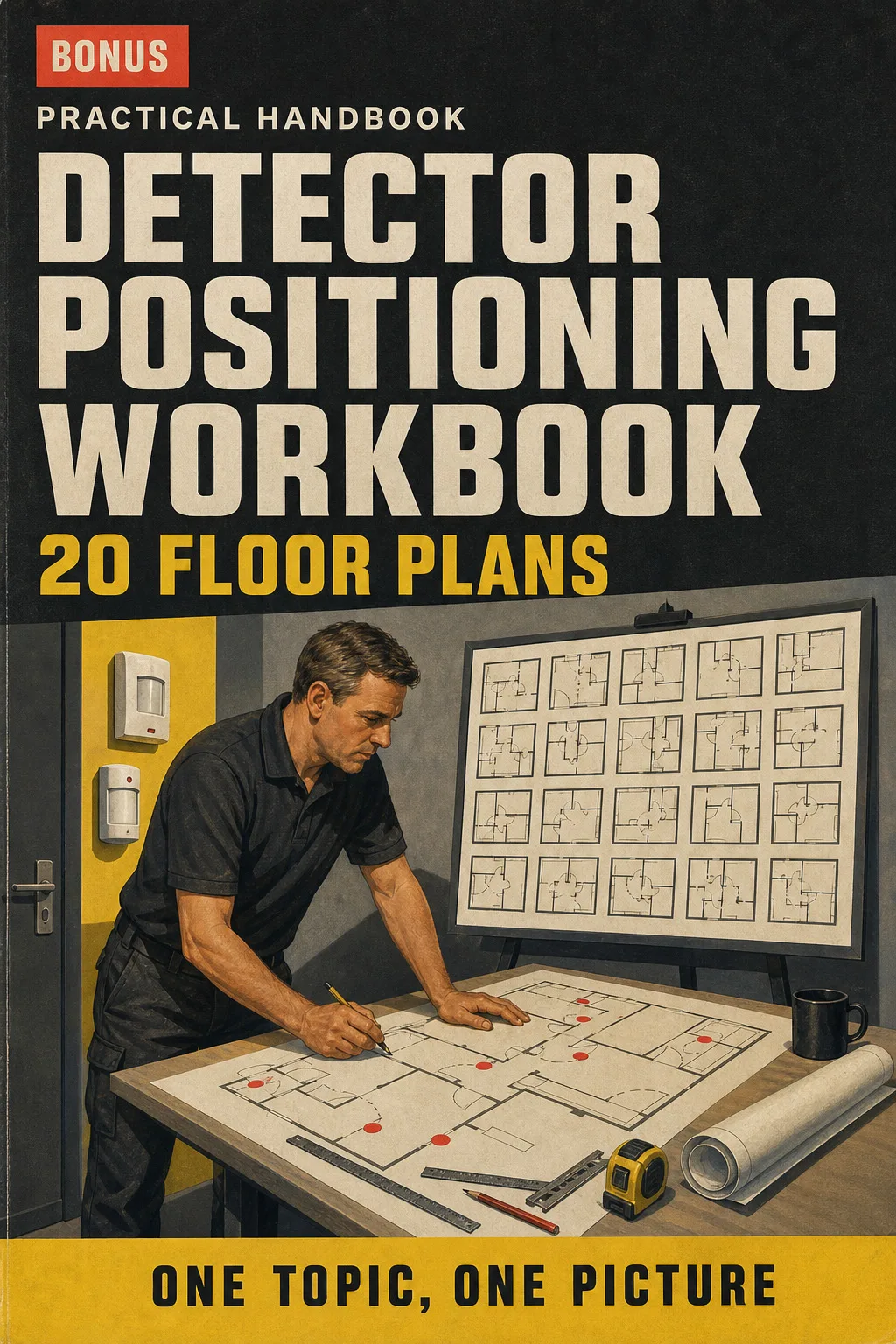
Detector Positioning Workbook: 20 Floor Plans

BONUS 1: «Detector Positioning Workbook: 20 Floor Plans»

Value on its own: US$ 17.90

Practise placing PIRs, contacts and sounders on 20 real-style floor plans, then check your layout against the drawn solution.

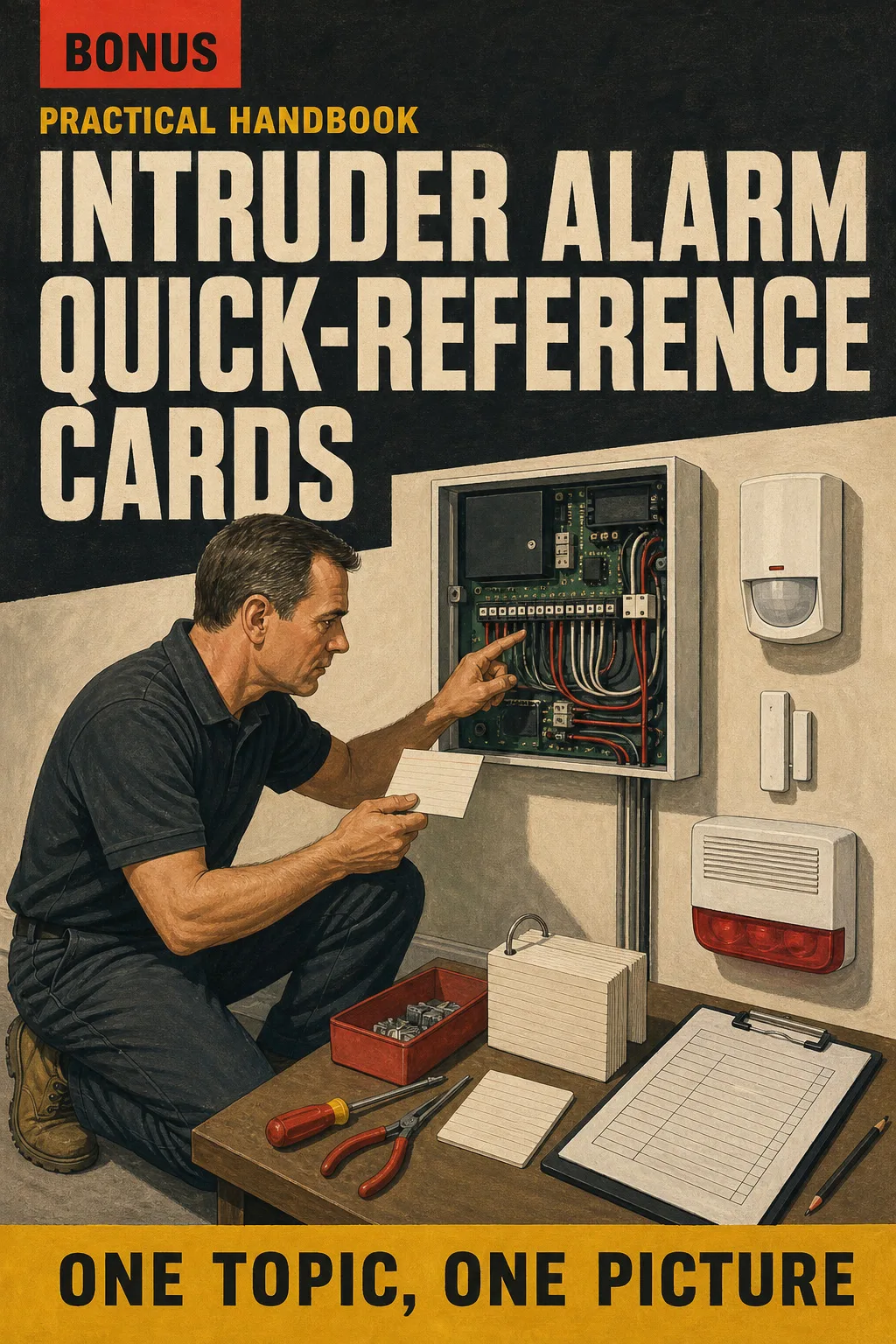
Intruder Alarm Quick-Reference Cards

BONUS 2: «Intruder Alarm Quick-Reference Cards»

Value on its own: US$ 14.90

The wiring loops, battery sizing steps, fault checks and most common mistakes on printable cards to keep in the van.

Intruder Alarm Installation Illustrated with 2 Free Books

  • Intruder Alarm Installation Illustrated: 65 illustrated pagesUS$ 63
  • BONUS 1: Detector Positioning Workbook: 20 Floor PlansUS$ 17.90
  • BONUS 2: Intruder Alarm Quick-Reference CardsUS$ 14.90
  • High-resolution PDF to printIncluded
Total value US$ 95.80
YOUR PRICE:
US$ 27
You save US$ 68.80
YES, I WANT INTRUDER ALARM INSTALLATION ILLUSTRATED FOR US$ 27

📄 This is a digital PDF book sent to your email: nothing is printed or shipped.

Secure purchaseEncrypted payment30-day guarantee

PDF by email: We email you Intruder Alarm Installation Illustrated as a PDF, together with the two free books. It's a single payment: no installments, no extra charges.

Who This Book Is For

You're adding alarms to your electrical work

You're adding alarms to your electrical work

You already know cable. The book draws the alarm logic on top of it: zones, EOL resistors, the tamper loop and the job in the same order every time.

You've got an alarm job booked

You've got an alarm job booked

Before you go, you check the survey, the detector positions and the dead checks page by page, so nothing on site catches you out.

You already fit and service alarms

You already fit and service alarms

Fault finding in five checks, the service checklist and the battery pages, printed and kept in the van for when the customer is stood behind you.

Everything You Get Today

US$ 95.80US$ 27
YES, I WANT INTRUDER ALARM INSTALLATION ILLUSTRATED FOR US$ 27

📄 This is a digital PDF book sent to your email: nothing is printed or shipped.

30DAYS
GUARANTEE

30-Day Guarantee

Try Intruder Alarm Installation Illustrated for 30 days, bonus books included.

We refund everything if the file won't open, if the book isn't what you see here, if you were charged twice or if the email doesn't arrive. Just email us.

You pay once. No subscriptions.

Frequently Asked Questions

Is it for me if I've been fitting alarms for years?

Yes. It isn't a beginner's course: it's the whole job drawn in one order, to check a loop, a position or a fault in seconds. It works with any panel brand, because it explains the principles; for panel-specific settings, always follow the manufacturer's manual.

Where does the content come from?

It's checked against BS EN 50131-1 with PD 6662, BS 9263, BS 8243, BS EN 50131-6 and the current edition of BS 7671, plus the current police requirements for remotely monitored alarms. It's written for the UK, not a generic or American book.

Is it official material?

No. It's an independent illustrated guide. It doesn't reproduce the text or tables of any standard and isn't linked to any standards body, police organisation or manufacturer.

Does it replace training, or give me a certificate?

No. It's a study and reference book. It doesn't give you a qualification or a certificate, and it doesn't replace proper training, the manufacturer's instructions or the current standards and wiring regulations.

Are the practice exercises taken from a course or assessment?

No. The 20 floor plans in the workbook are written for this book, with a drawn solution for each one.

When and how does it arrive?

As a PDF by email, together with the 2 bonus books, to the address you enter at checkout.

Do I have to pay every month?

No. It's a one-off payment.

Can I have it on paper?

Yes. It's a PDF you can print at home or at a print shop and keep in the van.

How does the refund work?

You have 30 days. We refund everything if the file won't open, if the book isn't what you see on this page, if you were charged twice or if the email doesn't arrive: just email us.

Before You Close This Page

No more rereading the panel manual and forgetting it.

The tamper loop and the EOL resistors, you see them drawn.

You arrive on site knowing where everything is.

Drawings make studying faster.

The book is right below.

One-time payment: US$ 27 · Guarantee: 30 days · PDF by email

YES, I WANT INTRUDER ALARM INSTALLATION ILLUSTRATED FOR US$ 27

📄 This is a digital PDF book sent to your email: nothing is printed or shipped.